

Cell Membrane Just Passing Through
3.7: Cell Transport
- Page ID
- 30626
Look at the big windows and glass doors in this firm. Imagine all the light they must let in on a sunny mean solar day. At present imagine living in a house that has walls without any windows or doors. Nothing could enter or get out. Or imagine living in a house with holes in the walls instead of windows and doors. Things could enter or leave, merely you lot couldn't control what came in or went out. Simply if a house has walls with windows and doors that tin be opened or closed yous can control what enters or leaves. For instance, windows and doors permit you to let in light and the family unit dog and keep out rain and bugs.
.jpg?revision=1&size=bestfit&width=441&height=285)
Ship Across Membranes
If a cell were a firm, the plasma membrane would be walls with windows and doors. Moving things in and out of the cell is an important role of the plasma membrane. It controls everything that enters and leaves the cell. There are two basic means that substances can cross the plasma membrane: passive transport, which requires no energy; and active transport, which requires energy. Passive transport is explained in this section and Agile transport is explained in the next department, Active Transport and Homeostasis. Diverse types of jail cell transport are summarized in the concept map in Effigy \(\PageIndex{2}\).
Send Without Free energy
Passive send occurs when substances cross the plasma membrane without any input of free energy from the cell. No free energy is needed because the substances are moving from an area where they have a college concentration to an area where they accept a lower concentration. Water solutions are very important in biological science. When water is mixed with other molecules this mixture is called a solution. Water is the solvent and the dissolved substance is the solute. A solution is characterized past the solute. For instance, water and carbohydrate would be characterized equally a sugar solution. More the particles of a solute in a given volume, the higher the concentration. The particles of solute always move from an expanse where information technology is more than full-bodied to an surface area where information technology is less concentrated. It's a petty like a ball rolling down a hill. It goes by itself without any input of extra free energy.
The different categories of jail cell send are outlined in Effigy \(\PageIndex{ii}\). Cell transport tin can exist classified every bit follows:
- Passive Send which includes
- Unproblematic Improvidence
- Osmosis
- Facilitated Improvidence
- Active Transport can involve either a pump or a vesicle
- Pump Transport can be
- primary
- secondary
- Vesicle Transport can involve
- Exocytosis
- Endocytosis which includes
- Pinocytosis
- Phagocytosis
- Receptor-Mediated Endocytosis
- Pump Transport can be
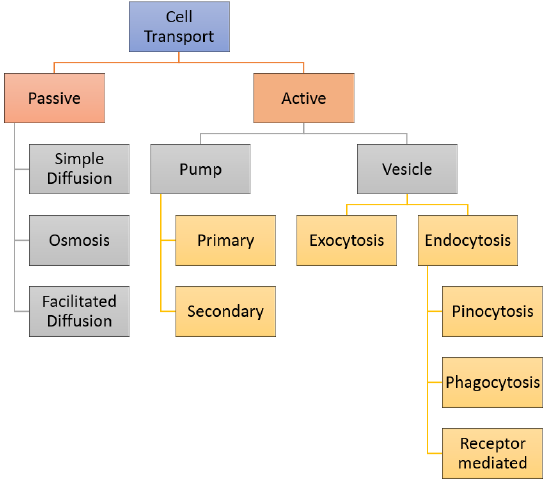
Figure \(\PageIndex{2}\): The Cell Ship Concept Map illustrates diverse types of cell transports that happen at the plasma membrane
Unproblematic Diffusion
Diffusion Although you may not know what improvidence is, yous have experienced the procedure. Can you think walking into the front door of your domicile and smelling a pleasant aroma coming from the kitchen? It was the diffusion of particles from the kitchen to the front door of the business firm that immune y'all to detect the odors. Diffusion is defined as the net movement of particles from an surface area of greater concentration to an expanse of bottom concentration.

The molecules in a gas, a liquid, or a solid are in constant motion due to their kinetic energy. Molecules are in abiding move and collide with each other. These collisions cause the molecules to move in random directions. Over time, however, more molecules will exist propelled into the less concentrated area. Thus, the cyberspace motility of molecules is always from more tightly packed areas to less tightly packed areas. Many things tin can diffuse. Odors diffuse through the air, salt diffuses through h2o and nutrients lengthened from the blood to the body tissues. This spread of particles through the random motion from an area of loftier concentration to an expanse of lower concentration is known as diffusion. This unequal distribution of molecules is called a concentration slope. Once the molecules get uniformly distributed, a dynamic equilibrium exists. The equilibrium is said to exist dynamic because molecules keep to motility, only despite this change, at that place is no internet alter in concentration over fourth dimension. Both living and nonliving systems experience the procedure of improvidence. In living systems, diffusion is responsible for the movement of a large number of substances, such as gases and small uncharged molecules, into and out of cells.
Osmosis
Osmosis is a specific type of improvidence; it is the passage of water from a region of high water concentration through a semi-permeable membrane to a region of low water concentration. Water moves in or out of a cell until its concentration is the same on both sides of the plasma membrane.
Semi-permeable membranes are very sparse layers of material that permit some things to pass through them just forbid other things from passing through. Cell membranes are an example of semi-permeable membranes. Jail cell membranes let modest molecules such as oxygen, water carbon dioxide, and oxygen to pass through but exercise non allow larger molecules like glucose, sucrose, proteins, and starch to enter the jail cell direct.
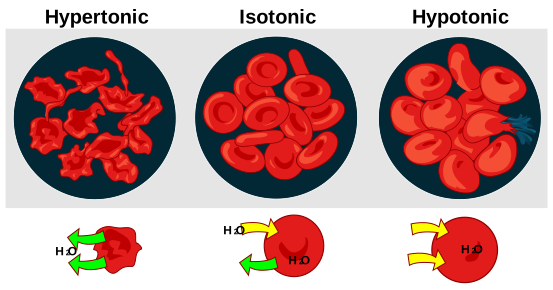
The classic example used to demonstrate osmosis and osmotic force per unit area is to immerse cells into carbohydrate solutions of diverse concentrations. At that place are three possible relationships that cells can encounter when placed into a sugar solution. Figure \(\PageIndex{4}\) shows what happens in osmosis through the semi-permeable membrane of the cells.
- The concentration of solute in the solution can be greater than the concentration of solute in the cells. This jail cell is described equally being in a hypertonic solution (hyper = greater than normal). The net catamenia or h2o volition exist out of the cell.
- The concentration of solute in the solution tin be equal to the concentration of solute in cells. In this situation, the cell is in an isotonic solution (iso = equal or the same equally normal). The amount of water inbound the cell is the aforementioned as the amount leaving the prison cell.
- The concentration of solute in the solution can be less than the concentration of solute in the cells. This cell is in a hypotonic solution (hypo = less than normal). The net flow of water will be into the cell.
Figure \(\PageIndex{5}\) demonstrates the specific outcomes of osmosis in red blood cells.
- Hypertonic solution. The ruby claret cell will announced to compress as the water flows out of the cell and into the surrounding environment.
- Isotonic solution. The red blood cell will retain its normal shape in this environment as the amount of water inbound the cell is the same equally the corporeality leaving the prison cell.
- Hypotonic solution. The blood-red blood prison cell in this environment will become visibly swollen and potentially rupture as water rushes into the cell.
Facilitated Diffusion
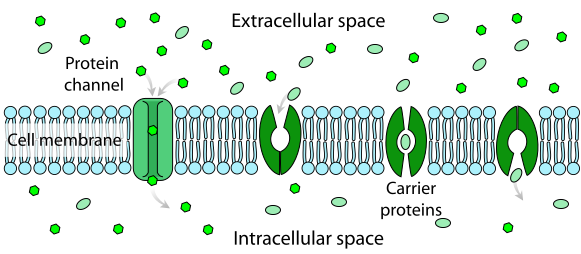
Water and many other substances cannot simply diffuse across a membrane. Hydrophilic molecules, charged ions, and relatively big molecules such as glucose all need aid with diffusion. The help comes from special proteins in the membrane known as transport proteins. Diffusion with the assist of transport proteins is called facilitated diffusion. There are several types of transport proteins, including channel proteins and carrier proteins (Figure \(\PageIndex{vi}\))
- Channel proteins class pores, or tiny holes, in the membrane. This allows water molecules and pocket-size ions to laissez passer through the membrane without coming into contact with the hydrophobic tails of the lipid molecules in the interior of the membrane.
- Carrier proteins bind with specific ions or molecules, and in doing so, they modify shape. Every bit carrier proteins modify shape, they carry the ions or molecules across the membrane.
Review
- What is the main divergence betwixt passive and active transport?
- Summarize three different means that passive transport can occur, and requite an instance of a substance that is transported in each way.
- Explain how transport across the plasma membrane is related to the homeostasis of the cell.
- Why can mostly simply very small, hydrophobic molecules across the prison cell membrane by elementary diffusion?
- Explain how facilitated diffusion assists in osmosis in cells. Be sure to define osmosis and facilitated diffusion in your answer.
- Imagine a hypothetical jail cell with a higher concentration of glucose within the jail cell than outside. Answer the following questions about this cell, bold all transport across the membrane is passive, not active.
- Tin the glucose simply diffuse across the cell membrane? Why or why non?
- Assuming that there are glucose transport proteins in the cell membrane, which manner would glucose menstruum – into or out of the prison cell? Explain your reply.
- If the concentration of glucose was equal inside and exterior of the cell, practice yous think at that place would be a internet period of glucose beyond the cell membrane in one direction or the other? Explain your answer.
- What are the similarities and differences between channel proteins and carrier proteins?
- True or Imitation. Just active transport, not passive transport, involves transport proteins.
- True or False. Oxygen and carbon dioxide tin can squeeze betwixt the lipid molecules in the plasma membrane.
- Truthful or False. Ions easily diffuse beyond the cell membrane by simple diffusion.
- Decision-making what enters and leaves the prison cell is an important part of the:
- nucleus
- vesicle
- plasma membrane
- Golgi apparatus
Explore More

Cell Membrane Just Passing Through,
Source: https://bio.libretexts.org/Courses/Community_College_of_Vermont/Human_Biology_(Gabor_Gyurkovics)/03%3A_Cells/3.07%3A_Cell_Transport
Posted by: martinhurping.blogspot.com
0 Response to "Cell Membrane Just Passing Through"
Post a Comment