

Fog Is An Example Of


Fog is a visible droplets consisting of tiny h2o aerosol or water ice crystals suspended in the air at or near the Earth'southward surface.[1] [2] Fog tin can be considered a type of low-lying deject usually resembling stratus, and is heavily influenced by nearby bodies of h2o, topography, and wind weather. In plow, fog affects many human activities, such as aircraft, travel, and warfare.
Fog appears when water vapor (water in its gaseous form) condenses. During condensation, molecules of water vapor combine to brand tiny liquid water droplets that hang in the air. Bounding main fog, which shows upwards near bodies of saline h2o, is formed as water vapor condenses on bits of common salt. Fog is similar to, just less transparent than, mist.
Definition [edit]
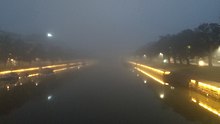
The term fog is typically distinguished from the more generic term cloud in that fog is low-lying, and the moisture in the fog is often generated locally (such equally from a nearby body of water, like a lake or the ocean, or from nearby moist basis or marshes).[iii]
Past definition, fog reduces visibility to less than one km (0.62 mi), whereas mist causes bottom impairment of visibility.[4]
For aviation purposes in the U.k., a visibility of less than v km (iii.one mi) merely greater than 999 one thousand (3,278 ft) is considered to be mist if the relative humidity is 95% or greater; beneath 95%, haze is reported.[5] [ full commendation needed ]
Formation [edit]

Minute droplets of h2o constitute this after-dark radiation fog, with an ambient temperature of −2 °C (28 °F). Their motility trails are captured every bit streaks.

Fog forms when the difference betwixt air temperature and dew bespeak is less than 2.5 °C (iv.5 °F).[6] [seven]
Fog begins to grade when h2o vapor condenses into tiny water aerosol that are suspended in the air. Some examples of ways that water vapor is added to the air are by wind convergence into areas of upward motility;[viii] atmospheric precipitation or virga falling from higher up;[9] daytime heating evaporating water from the surface of oceans, water bodies, or wet land;[10] transpiration from plants;[11] cool or dry air moving over warmer water;[12] and lifting air over mountains.[13] Water vapor ordinarily begins to condense on condensation nuclei such as dust, ice, and salt in society to grade clouds.[14] [15] Fog, similar its elevated cousin stratus, is a stable cloud deck which tends to class when a cool, stable air mass is trapped underneath a warm air mass.[16]
Fog normally occurs at a relative humidity near 100%.[17] This occurs from either added moisture in the air, or falling ambience air temperature.[17] However, fog tin grade at lower humidities, and tin can sometimes fail to grade with relative humidity at 100%. At 100% relative humidity, the air cannot agree additional moisture, thus, the air will become supersaturated if additional moisture is added.
Fog usually produces atmospheric precipitation in the form of drizzle or very light snow. Drizzle occurs when the humidity of fog attains 100% and the minute cloud aerosol begin to coalesce into larger droplets.[18] This can occur when the fog layer is lifted and cooled sufficiently, or when it is forcibly compressed from above by descending air. Drizzle becomes freezing drizzle when the temperature at the surface drops below the freezing bespeak.
The thickness of a fog layer is largely determined by the altitude of the inversion purlieus, which in coastal or oceanic locales is also the top of the marine layer, above which the air mass is warmer and drier. The inversion boundary varies its altitude primarily in response to the weight of the air higher up it, which is measured in terms of atmospheric pressure level. The marine layer, and any fog-bank it may contain, will be "squashed" when the force per unit area is loftier, and conversely, may expand upwardly when the pressure to a higher place information technology is lowering.
Types [edit]
Fog can grade in a number of ways, depending on how the cooling that caused the condensation occurred.
Radiation fog is formed by the cooling of land afterwards sunset by infrared thermal radiations in at-home conditions with a clear heaven. The cooling ground then cools side by side air by conduction, causing the air temperature to fall and reach the dew bespeak, forming fog. In perfect calm, the fog layer can be less than a meter thick, just turbulence can promote a thicker layer. Radiation fog occurs at night, and normally does not terminal long later sunrise, but it tin can persist all day in the winter months, especially in areas bounded past high ground. Radiation fog is most common in fall and early winter. Examples of this miracle include tule fog.[nineteen]
Ground fog is fog that obscures less than 60% of the heaven and does not extend to the base of operations of any overhead clouds.[20] However, the term is commonly a synonym for shallow radiations fog; in some cases the depth of the fog is on the order of tens of centimetres over certain kinds of terrain with the absence of wind.

Advection fog occurs when moist air passes over a cool surface past advection (wind) and is cooled.[21] It is common as a warm forepart passes over an expanse with meaning snow-pack. It is nearly mutual at sea when moist air encounters libation waters, including areas of cold water upwelling, such as along the California coast (run into San Francisco fog). A strong enough temperature difference over water or bare ground can as well cause advection fog.
Although strong winds often mix the air and tin disperse, fragment, or preclude many kinds of fog, markedly warmer and humid air blowing over a snowpack can continue to generate advection fog at elevated velocities up to 80 km/h (fifty mph) or more than – this fog will be in a turbulent, chop-chop moving, and comparatively shallow layer, observed as a few centimetres/inches in depth over flat farm fields, flat urban terrain and the like, and/or form more complex forms where the terrain is different such equally rotating areas in the lee of hills or big buildings and so on.
Fog formed by advection forth the California coastline is propelled onto land by one of several processes. A cold front end can push the marine layer coast-ward, an occurrence most typical in the jump or late fall. During the summer months, a depression-pressure level trough produced by intense heating inland creates a strong pressure level gradient, cartoon in the dense marine layer. Also, during the summer, strong high pressure aloft over the desert southwest, ordinarily in connection with the summer monsoon, produces a south to southeasterly flow which can drive the offshore marine layer up the coastline; a phenomenon known equally a "southerly surge", typically following a coastal heat spell. However, if the monsoonal flow is sufficiently turbulent, it might instead interruption up the marine layer and any fog information technology may contain. Moderate turbulence will typically transform a fog bank, lifting information technology and breaking information technology upwardly into shallow convective clouds chosen stratocumulus.
Evaporation fog or steam fog forms over bodies of h2o overlain by much colder air; this state of affairs can also lead to the germination of steam devils, which look similar their dust counterparts.[22] Lake effect fog is of this type, sometimes in combination with other causes like radiation fog. It tends to differ from most advective fog formed over land in that it is, like lake-outcome snowfall, a convective miracle, resulting in fog that tin can exist very dense and deep and looks fluffy from above.
Frontal fog forms in much the aforementioned way as stratus cloud nearly a front when raindrops, falling from relatively warm air higher up a frontal surface, evaporate into cooler air close to the World's surface and cause information technology to get saturated. This blazon of fog can be the result of a very low frontal stratus cloud subsiding to surface level in the absence of any lifting amanuensis later on the front end passes.
Ice fog forms in very depression temperatures and can be the result of other mechanisms mentioned hither, besides as the exhalation of moist warm air by herds of animals. Information technology tin exist associated with the diamond dust course of precipitation, in which very small crystals of ice form and slowly fall. This often occurs during blueish sky conditions, which can cause many types of halos and other results of refraction of sunlight by the airborne crystals.
Freezing fog, which deposits rime, is composed of aerosol of supercooled water that freeze to surfaces on contact.[23]
Precipitation fog (or frontal fog) forms every bit precipitation falls into drier air below the deject, the liquid droplets evaporate into water vapor. The h2o vapor cools and at the dewpoint it condenses and fog forms.
Hail fog sometimes occurs in the vicinity of pregnant hail accumulations due to decreased temperature and increased wet leading to saturation in a very shallow layer most the surface. It well-nigh often occurs when there is a warm, boiling layer atop the hail and when wind is light. This basis fog tends to be localized but tin be extremely dense and abrupt. It may form shortly afterward the hail falls; when the hail has had time to absurd the air and as it absorbs heat when melting and evaporating.[24]
Upslope fog forms when moist air is going upwards the slope of a mountain or loma (orographic lifting) which condenses into fog on account of adiabatic cooling, and to a lesser extent the drop in pressure with distance.
Freezing conditions [edit]
Freezing fog occurs when liquid fog droplets freeze to surfaces, forming white soft or hard rime.[25] This is very common on mountain tops which are exposed to low clouds. Information technology is equivalent to freezing rain, and essentially the aforementioned as the ice that forms within a freezer which is not of the "frostless" or "frost-free" type. The term "freezing fog" may as well refer to fog where water vapor is super-cooled, filling the air with small ice crystals similar to very light snowfall. It seems to brand the fog "tangible", every bit if one could "catch a handful".
In the western U.s.a., freezing fog may be referred to as pogonip.[26] It occurs commonly during common cold wintertime spells, commonly in deep mount valleys. The word pogonip is derived from the Shoshone word paγi̵nappi̵h, which means "cloud".[26] [27] In The One-time Farmer's Annual, in the calendar for December, the phrase "Beware the Pogonip" regularly appears. In his anthology Smoke Bellew, Jack London described a pogonip which surrounded the main characters, killing i of them.
The phenomenon is also extremely common in the inland areas of the Pacific Northwest, with temperatures in the 10 to 30 °F (−12 to −1 °C) range. The Columbia Plateau experiences this phenomenon nearly years due to temperature inversions, sometimes lasting for every bit long every bit three weeks. The fog typically begins forming around the area of the Columbia River and expands, sometimes covering the land to distances as far abroad as LaPine, Oregon, well-nigh 150 miles (240 km) due south of the river and into south primal Washington.
Frozen fog (also known as ice fog) is any kind of fog where the droplets have frozen into extremely tiny crystals of ice in midair. More often than not, this requires temperatures at or beneath −35 °C (−31 °F), making information technology common only in and near the Arctic and Antarctic regions.[28] It is near oft seen in urban areas where it is created by the freezing of h2o vapor present in automobile exhaust and combustion products from heating and power generation. Urban ice fog can become extremely dense and will persist day and dark until the temperature rises. Extremely small amounts of ice fog falling from the sky form a type of precipitation called ice crystals, often reported in Utqiaġvik, Alaska. Water ice fog frequently leads to the visual phenomenon of calorie-free pillars.
-

Tree in field during extreme cold with frozen fog
Topographical influences [edit]


Up-slope fog or hill fog forms when winds blow air up a slope (called orographic lift), adiabatically cooling information technology as information technology rises, and causing the moisture in information technology to condense. This often causes freezing fog on mountaintops, where the cloud ceiling would not otherwise be low plenty.
Valley fog forms in mountain valleys, often during winter. It is essentially a radiation fog confined by local topography, and can final for several days in at-home weather condition. In California'south Central Valley, valley fog is oftentimes referred to as tule fog.
Body of water and coastal fog [edit]
Sea fog (also known every bit haar or fret) is heavily influenced by the presence of bounding main spray and microscopic airborne salt crystals. Clouds of all types require minute hygroscopic particles upon which water vapor can condense. Over the ocean surface, the most mutual particles are salt from common salt spray produced by breaking waves. Except in areas of storminess, the most common areas of breaking waves are located virtually coastlines, hence the greatest densities of airborne salt particles are there.
Condensation on salt particles has been observed to occur at humidities as low as 70%, thus fog can occur even in relatively dry air in suitable locations such as the California coast. Typically, such lower humidity fog is preceded by a transparent blur along the coastline every bit condensation competes with evaporation, a phenomenon that is typically noticeable past beachgoers in the afternoon. Another recently discovered source of condensation nuclei for littoral fog is kelp seaweed. Researchers take plant that nether stress (intense sunlight, strong evaporation, etc.), kelp releases particles of iodine which in turn become nuclei for condensation of water vapor, causing fog that diffuses direct sunlight.[29]
Sea fume, also called steam fog or evaporation fog, is the near localized course and is created by common cold air passing over warmer water or moist state.[25] It frequently causes freezing fog, or sometimes hoar frost.
Chill ocean fume is similar to sea smoke, but occurs when the air is very cold. Instead of condensing into water droplets, columns of freezing, rising, and condensing water vapor is formed. The water vapor produces the ocean smoke fog, and is usually misty and smoke-like.[thirty]
Garúa fog near the coast of Chile and Peru,[31] occurs when typical fog produced by the sea travels inland, simply suddenly meets an surface area of hot air. This causes the water particles of fog to shrink by evaporation, producing a "transparent mist". Garua fog is nigh invisible, even so it withal forces drivers to use windshield wipers because of deposition of liquid water on hard surfaces. Camanchaca is a similar, dense fog.
-
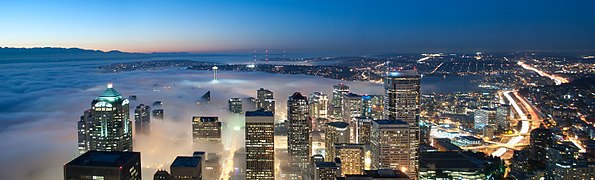
Fog rolls into Seattle from the sea
Visibility furnishings [edit]


Light fog reduces visibility on a suburban street, rendering the cyclist very hazy at about 200 g (220 yd). The limit of visibility is nigh 400 thou (440 yd), which is before the end of the street.
Depending on the concentration of the droplets, visibility in fog can range from the appearance of haze, to near aught visibility. Many lives are lost each year worldwide from accidents involving fog conditions on the highways, including multiple-vehicle collisions.
The aviation travel manufacture is affected by the severity of fog weather condition. Fifty-fifty though mod auto-landing computers can put an aircraft downwardly without the aid of a pilot, personnel manning an airport control tower must exist able to run across if aircraft are sitting on the runway awaiting takeoff. Safe operations are difficult in thick fog, and noncombatant airports may forbid takeoffs and landings until conditions ameliorate.
A solution for landing returning military aircraft developed in World War II was called Fog Investigation and Dispersal Operation (FIDO). Information technology involved burning enormous amounts of fuel alongside runways to evaporate fog, allowing returning fighter and bomber pilots sufficient visual cues to safely land their aircraft. The high energy demands of this method discourage its use for routine operations.
Shadows [edit]
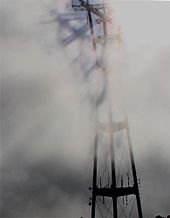
Shadows are cast through fog in three dimensions. The fog is dense enough to be illuminated by lite that passes through gaps in a construction or tree, simply thin enough to let a large quantity of that light pass through to illuminate points further on. As a result, object shadows appear equally "beams" oriented in a direction parallel to the calorie-free source. These voluminous shadows are created the aforementioned style as crepuscular rays, which are the shadows of clouds. In fog, it is solid objects that bandage shadows.
Sound propagation and acoustic effects [edit]
Sound typically travels fastest and farthest through solids, then liquids, then gases such every bit the atmosphere. Sound is afflicted during fog conditions due to the modest distances between water droplets, and air temperature differences.
Molecular effect: Though fog is essentially liquid h2o, the many droplets are separated by minor air gaps. High-pitched sounds have a high frequency, which in turn means they take a curt wavelength. To transmit a high frequency wave, air must move back and forth very apace. Short-wavelength high-pitched sound waves are reflected and refracted past many separated water droplets, partially cancelling and dissipating their energy (a process called "damping"). In contrast, low pitched notes, with a depression frequency and a long wavelength, move the air less rapidly and less often, and lose less energy to interactions with pocket-sized water aerosol. Low-pitched notes are less affected past fog and travel further, which is why foghorns employ a depression-pitched tone.[32]
Temperature effect: A fog can be caused past a temperature inversion where common cold air is pooled at the surface which helped to create the fog, while warmer air sits above it. The inverted boundary between common cold air and warm air reflects sound waves back toward the footing, allowing audio that would commonly radiate out escaping into the upper temper to instead bounce dorsum and travel near the surface. A temperature inversion increases the distance that lower frequency sounds tin travel, by reflecting the audio between the ground and the inversion layer.[33]
Tape extremes [edit]
Particularly foggy places include[ citation needed ] Hamilton, New Zealand and 1000 Banks off the coast of Newfoundland (the coming together place of the cold Labrador Current from the north and the much warmer Gulf Stream from the south). Some very foggy land areas in the world include Argentia (Newfoundland) and Point Reyes (California), each with over 200 foggy days per twelvemonth.[ citation needed ] Even in generally warmer southern Europe, thick fog and localized fog are often constitute in lowlands and valleys, such every bit the lower office of the Po Valley and the Arno and Tiber valleys in Italian republic; Ebro Valley in northeastern Spain; too equally on the Swiss plateau, especially in the Seeland area, in late autumn and wintertime.[ citation needed ] Other notably foggy areas include coastal Chile (in the south); coastal Namibia; Nord, Greenland; and the Severnaya Zemlya islands.[ citation needed ]
As a water source [edit]
Redwood forests in California receive approximately 30–40% of their moisture from littoral fog by style of fog baste. Modify in climate patterns could upshot in relative drought in these areas.[34] Some animals, including insects, depend on moisture fog equally a primary source of water, particularly in otherwise desert climes, every bit along many African coastal areas. Some coastal communities use fog nets to extract moisture from the temper where groundwater pumping and rainwater drove are insufficient. Fog can exist of unlike type according to climatic conditions.
Artificial fog [edit]
Artificial fog is homo-made fog that is usually created by vaporizing a h2o- and glycol- or glycerine-based fluid. The fluid is injected into a heated metal block, and evaporates apace. The resulting pressure forces the vapor out of a vent. Upon coming into contact with cool outside air, the vapor condenses in microscopic droplets and appears as fog.[35] Such fog machines are primarily used for amusement applications.
Historical references [edit]
The presence of fog has often played a key role in historical events, such equally strategic battles. One case is the Battle of Long Island (27 August 1776), when American general George Washington and his command were able to evade imminent capture by the British Army, using fog to muffle their escape. Another example is D-Day (six June 1944) during World War II, when the Allies landed on the beaches of Normandy, France during fog conditions. Both positive and negative results were reported from both sides during that battle, due to impaired visibility.[36]
Gallery [edit]
-

Maple tree with red leaves in the morning mist, in western Republic of estonia
-

A fog on the field of the Leppälahti ja Kuivaniemi villages in Kuopio, Finland
-

Dumbo fog over Indian subcontinent, captured past NASA's Aqua satellite in Dec 2012
-

Fog partially obscuring a mountain in Tirupati in the Republic of india summer.
-

Fog, in the form of a cloud, descends upon a Loftier Desert community in the western U.s.a., while leaving the mountain exposed.
See likewise [edit]
Technology [edit]
- Anti-fog
- Automotive lighting
- Decontamination cream
- Fog Investigation and Dispersal Operation (FIDO)
- Fog collection
- Foghorn
- Fog machine
- Fogging (photography)
- Fog lamp
- Head-up brandish
- Rail visual range
- Transmissometer
Weather [edit]
- Cloud
- Fog season
- Haboob (sandstorm)
- Mist
- San Francisco fog
- Smoke
- Smog
- Whiteout (weather)
- Vog
- Stratus
Other [edit]
- Multi-vehicle collision
References [edit]
- ^ Gultepe, Ismail, ed. (2 January 2008). "Fog Visibility and Forecasting". Fog and Boundary Layer Clouds. p. 1126. ISBN978-3-7643-8418-0. Archived from the original on 3 September 2016.
The international definition of fog consists of a suspended collection of water droplets or ice crystal near the Earth's surface...
Reprint from Pure and Practical Geophysics. 164 (6–7). 2007.{{cite journal}}: CS1 maint: untitled periodical (link) - ^ "What'south the Difference Between Fog and Clouds?". NOAA. 2022.
- ^ Employ of the term "fog" to mean any cloud that is at or virtually the Globe'south surface tin upshot in ambiguity as when, for example, a stratocumulus cloud covers a mountaintop. An observer on the mountain may say that he or she is in a fog, however, to outside observers a cloud is covering the mountain. (Thomas, P. (2005). Standard practice for the blueprint and performance of supercooled fog dispersal projects. p. 3. ISBN0-7844-0795-9. Archived from the original on 3 September 2016. Retrieved 27 March 2016. ) In fact, some people commonly mistake mist for fog. These ii are a trivial bit different as mist is thinner than fog. () Farther distinguishing the terms, fog rarely results in rain, while clouds are the common source of rain.
- ^ "Federal Meteorological Handbook Number 1: Chapter 8 – Present Weather condition" (PDF). Office of the Federal Coordinator for Meteorology. 1 September 2005. pp. 8–one, viii–2. Archived from the original (PDF) on 21 May 2011. Retrieved 9 October 2010.
- ^ Annex 3 (17th ed.), July 2010
- ^ "Fog – AMS Glossary". Archived from the original on 27 March 2013. Retrieved sixteen March 2013.
- ^ "Fog" (PDF). National Weather condition Service. 2022.
- ^ Robert Penrose Pearce (2002). Meteorology at the Millennium. Bookish Press. p. 66. ISBN978-0-12-548035-2 . Retrieved 2 January 2009.
- ^ "Virga and Dry Thunderstorms". National Weather Service Office, Spokane, Washington. Archived from the original on 22 May 2009.
- ^ Bart van den Hurk; Eleanor Blyth (2008). "Global maps of Local Land-Atmosphere coupling" (PDF). KNMI. Archived from the original (PDF) on 25 February 2009. Retrieved 2 January 2009.
- ^ Krishna Ramanujan; Brad Bohlander (2002). "Landcover changes may rival greenhouse gases as cause of climatic change". National Aeronautics and Infinite Administration Goddard Space Flying Centre. Archived from the original on 3 June 2008. Retrieved ii January 2009.
- ^ National Atmospheric condition Service JetStream (2008). "Air Masses". Archived from the original on 24 Dec 2008. Retrieved two January 2009.
- ^ Michael Pidwirny (2008). "Chapter 8: Introduction to the Hydrosphere (e). Deject Germination Processes". Physical Geography. Archived from the original on 20 December 2008. Retrieved one January 2009.
- ^ "Front end". Glossary of Meteorology. American Meteorological Club. 25 April 2012. Archived from the original on ten Oct 2018.
- ^ Roth, David M. (14 December 2006). "Unified Surface Analysis Transmission" (PDF). Hydrometeorological Prediction Heart. Archived (PDF) from the original on 29 September 2006. Retrieved 9 October 2010.
- ^ FMI (2007). "Fog And Stratus – Meteorological Concrete Background". Zentralanstalt für Meteorologie und Geodynamik. Archived from the original on 6 July 2011. Retrieved seven February 2009.
- ^ a b Gleissman, Stephe (2007). Agroecology: the ecology of sustainable food systems. CRC Press. p. 73. ISBN 0849328454.
- ^ Allred, Lance (2009). Enchanted Rock: A Natural and Man History. University of Texas Press. p. 99. ISBN 0292719639.
- ^ Cox, Robert Eastward. Applying Fog Forecasting Techniques using AWIPS and the Internet Archived 29 October 2007 at the Wayback Machine. National Atmospheric condition Service, 2007. nwas.org
- ^ Climate pedagogy update: News and data well-nigh climate change for teachers and students Archived 27 May 2010 at the Wayback Machine. Atmospheric Radiation Measurement. Climate Research Facility. U.Due south. Department of Energy. instruction.arm.gov
- ^ Frost, Helen (2004). Fog. Capstone Press. p. 22. ISBN978-0-7368-2093-vi.
- ^ "Fog Facts". Fast Facts for Kids. 2022.
- ^ "NWS Glossary". National Conditions Service. 2022.
- ^ Marshall, T., Hoadley, D. (1995). Tempest Talk. Tim Marshall.[ full commendation needed ]
- ^ a b Understanding Atmospheric condition – Fog Archived 31 January 2009 at the Wayback Car. BBC Atmospheric condition. bbc.co.uk
- ^ a b "pogonip". Merriam-Webster Dictionary.
- ^ "Pogonip - Definition from the Dictionary.com". Archived from the original on 22 February 2014. Retrieved 2 January 2013.
- ^ Haby, Jeff. What is the difference between ice fog and freezing fog? Archived eight Jan 2006 at the Wayback Machine theweatherprediction.com
- ^ Stressed seaweed contributes to cloudy coastal skies, study suggests Archived eleven May 2008 at the Wayback Auto, eurekalert.org
- ^ "Arctic Sea Smoke". encyclopedia.com. Archived from the original on six May 2016.
- ^ Cowling, R. M., Richardson, D. Yard., Pierce, S. M. (2004). Vegetation of Southern Africa. Cambridge Academy Press. p. 192. ISBN 0521548012.
- ^ "Does fog have a dampening effect on sounds?". thenakedscientists.com. fourteen June 2009. Archived from the original on 16 January 2015.
- ^ "How fog can play tricks on your ears?". katu.com. Archived from the original on 12 April 2015.
- ^ Joyce, Christopher (23 February 2010). "Fog Fluctuations Could Threaten Giant Redwoods". NPR. Archived from the original on 27 Jan 2016.
- ^ Karukstis, Yard. K., Van Hecke, Chiliad. R. (2003). Chemistry connections: the basis of everyday phonemena. Academic Press. p. 23. ISBN 0124001513.
- ^ Tardif, Robert Thou. (2007). Characterizing fog and the physical mechanisms leading to its germination during precipitation in a coastal expanse of the northeastern United States. Bibcode:2007PhDT........70T.
- ^ "Sunset Panorama at La Silla". eso.org. Archived from the original on 28 Nov 2015.
Nether "[ ^ "Federal Meteorological Handbook Number one: Affiliate 8 – Nowadays Atmospheric condition" (PDF). Office of the Federal Coordinator for Meteorology. 1 September 2005. pp. viii–1, 8–2. Retrieved 9 October 2010. ] " ….
Actually use the following link- http://www.ofcm.gov/publications/fmh/FMH1/FMH1.pdf and proceed to Affiliate viii, etc.
Farther reading [edit]
- Ahrens, C. (1991). Meteorology today: an introduction to weather condition, climate, and the environment. Due west Pub. Co. ISBN 978-0-314-80905-6.
- Corton, Christine Fifty. London Fog: The Biography (2015)
- Riddle, Laurence K.; Cayan, Daniel R.; Filonczuk, Maria K. (1 July 1995). "Variability of Marine Fog Along the California Declension".
- Lu, Chunsong; Liu, Yangang; Niu, Shengjie; Zhao, Lijuan; Yu, Huaying; Cheng, Muning (30 Jan 2014). "Examination of microphysical relationships and corresponding microphysical processes in warm fogs". Acta Meteorologica Sinica. 27 (6): 832–848. doi:ten.1007/s13351-013-0610-0. S2CID 2471958.
- Lu, Chunsong; Niu, Shengjie; Tang, Lili; Lv, Jingjing; Zhao, Lijuan; Zhu, Bin (July 2010). "Chemical composition of fog water in Nanjing area of Mainland china and its related fog microphysics". Atmospheric Research. 97 (1–ii): 47–69. Bibcode:2010AtmRe..97...47L. doi:10.1016/j.atmosres.2010.03.007.
External links [edit]

Wikimedia Commons has media related to Fog.
- Social & Economic Costs of Fog from "NOAA Socioeconomics" website initiative
- United States' current dumbo fog advisories from NOAA
- Current Western US fog satellite pictures from NOAA

Fog Is An Example Of,
Source: https://en.wikipedia.org/wiki/Fog
Posted by: martinhurping.blogspot.com
0 Response to "Fog Is An Example Of"
Post a Comment