

Major Scales In Bass Clef
The major scales are the edifice blocks of music, mastering them is the first step to learning to play rapidly in any key.
What Are Scales
Scales are collections of the 8 notes that make upward a key. If you were to use but those notes, you could make melodies and harmonies that would audio skilful together. For y'all history buffs, or if you merely want to rock on trivia nighttime, and so remember that the give-and-take scale comes from the Latin word "Scala," which means ladder. If you lot look at a scale, it looks like a ladder where each rung is a annotation that fits in the key signature.
There are several categories of scales: Major, minors, and modes.
When reading scales, you'll notice that the key is fix in the central signature, not by accidentals on each notation.
Each key also has character traits. Some seem angry and could be used when writing pieces about war, others sad, and some joyous.
What is a major calibration?
A major calibration is made up of vii unique notes (and ane repeated) that span the range of an octave. The distance between notes in a major scale ever follow this blueprint: whole, whole, one-half, whole, whole, whole, half.
Each note in a major scale can also be called a "Calibration caste." - 1st: Tonic - 2d: Supertonic - 3rd: Mediant - 4th: Subdominant - 5th: Dominant - sixth: Submediant - 7th: Leading Tone - eighth: Tonic (again)
To brand that indicate more clear, expect at the example of the C Major scale below. The first notation in that scale is "C." I could call C the "Tonic." E would be the mediant and G would be the dominant.
The 12-Major Scales
C Major Calibration
The C-Major scale is 1 of the first scales we larn considering it doesn't incorporate any sharps or flats. 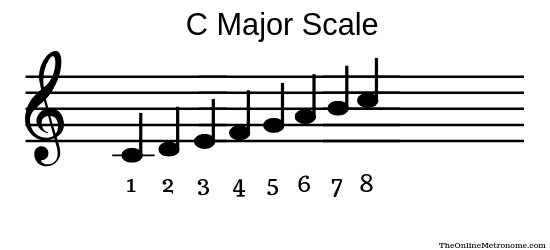
The C-Major scale is made of the notes: C, D, E, F, G, A, B, C. If you were to play this calibration on the piano, it would contain merely white keys.
Since in that location are no sharps or flats in C-Major, it is considered to have a "pure" character. Information technology conveys a sense of innocence and simplicity. I of the nearly famous symphonies in C Major is Beethoven's Symphony No. ane.
D Major Scale
The D-Major scale contains two sharps in the key signature, F-sharp and C-abrupt. 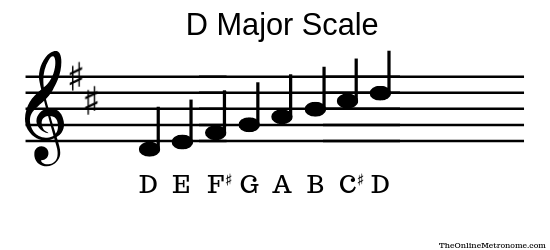
The D-Major scale is made upwardly of the notes: D, Eastward, F-sharp, G, A, B, C-sharp, and D.
The central of D is representative of triumph and victory. For this reason, many marches, religious, and holiday songs are written in D-Major. Brahms' Symphony No. 2 is in D-Major is an example of a composition using this key.
E Major Scale
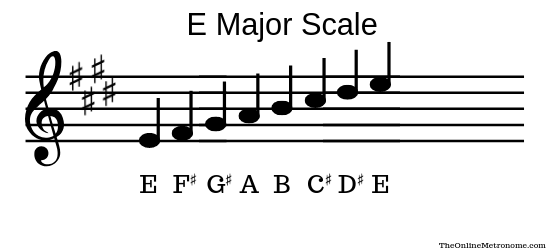
E-Major contains four sharps. The scale is comprised of: E, F-precipitous, G-sharp, A, B, C-abrupt, D-sharp, and E.
The cardinal of E-Major is a joyous cardinal, even sometimes described every bit "joyous laughter." A symphony that uses the key of East-Major is Anton Bruckner'south Symphony No. 7.
F Major Scale
The key of F-Major has one flat, B-flat. It is made up of: F, 1000, A, B-flat, C, D, E, F. 
The key of F-Major is described as complacent and calm. Antonin Dvorak'south Symphony No. 5 in F-Major is written in a pastoral style, which explains why he chose this key for his limerick.
G Major Scale
The central of One thousand-Major has but one sharp: F-sharp. It'due south comprised of the notes: G, A, B, C, D, Eastward, F-sharp, One thousand. 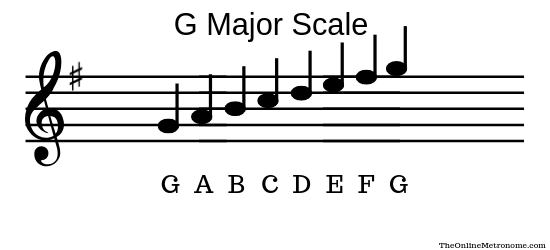
The key of K-Major is rustic and idyllic. It evokes feelings of tenderness and friendship. Gustav Mahler's Symphony No. 4 is a good case, as information technology is meant to describe a kid's view of Sky.
A Major Scale
A-Major has three sharps (F-abrupt, C-sharp, and 1000-sharp). The scale is made upwards past: A, B, C-Abrupt, D, E, F-Abrupt, G-Sharp, A. 
The cardinal of A Major elicits feelings of innocent love and trust. Felix Mendelssohn's Symphony No. 4 is in A-Major. Mendelssohn was inspired to compose this piece of work past the beauty of Italy. He said "This is Italia! And now has begun what I take always thought... to be the supreme joy in life. And I am loving it."
B Major Calibration
B-Major has five sharps in the cardinal signature. They are F-sharp, C-sharp, M-abrupt, D-sharp, and A-sharp. The scale is made up of: B, C-sharp, D-sharp, E, F-sharp, G-sharp, A-sharp, B. 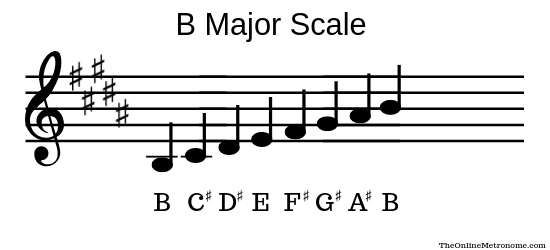
The key of B-Major is i of wild passion. It can represent emotions of intense honey, anger, jealousy, and rage. Information technology is one of the few major keys that symbolizes negative emotions. Dmitri Shostakovich's Symphony No. ii is written in B-Major, which was written to commemorate the 10th ceremony of the October Revolution. Information technology was an upshot that was seen as triumphant merely also was an armed insurrection. This highlights the disharmonize between dear and rage.
D-Apartment Major Scale
The next two scales, D-Apartment Major and C-Sharp major are enharmonic equivalents.
This means that while they await different, they will audio the same. C-abrupt and D-flat are the aforementioned pitch. That said, some people have an easier time reading sharp or flats, and one of these keys might make more than sense when looking at related keys or chord progressions.
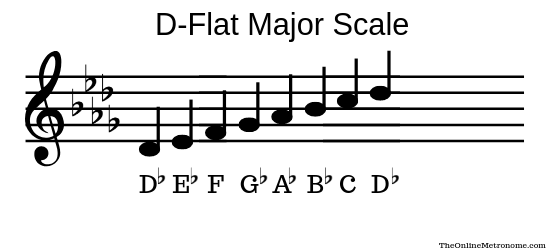
The D-Flat Major scale has 5 flats: B-flat, E-apartment, A-apartment, D-apartment, and Thousand-flat. It is a key described as beingness moderate but capable of expressing a range of emotions. It can be happy, but not joyous, or it tin can be sad, but not in agonizing hurting. A symphony equanimous in D-Flat is Howard Hanson'south Symphony No. 2.
C-Sharp Major Calibration
At present that you know the D-Apartment major scale, you also know the C-Sharp major calibration. Go note by notation through these ii scales and you will see that they are the same, but expressed differently.
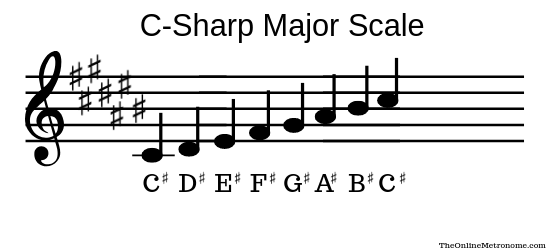
The C-Sharp major scale has vii sharps: F, C, G, D, A, E, B. So yes, every single annotation in this scale is sharp. Since this calibration sounds, to the ear, the aforementioned as the D-Flat Major scale, it has similar musical character traits. That said, in compositions, these two keys might be approached differently, which volition have a dramatic touch on on the feelings they convey. Many more composers have written symphonies in C-sharp over D-flat. One famous example is Mahler'due south Symphony No. 5.
E-Apartment Major Scale
Eastward-flat Major has three flats: B-apartment, E-apartment, and A-apartment.
Due east-apartment is the cardinal of dear and devotion and is made up of the notes: East-flat, F, Thousand, A-flat, B-apartment, C, D, and E-flat. A famous piece of work in the key of East-apartment is Beethoven'south Symphony No. 3 "Eroica". This slice was originally defended to Napoleon, which speaks to the idea of admiration (love and devotion).
Yard-Flat Major Calibration
The Grand-Apartment Major scale is another scale that is an enharmonic equivalent. G-apartment can besides be written as F-abrupt.
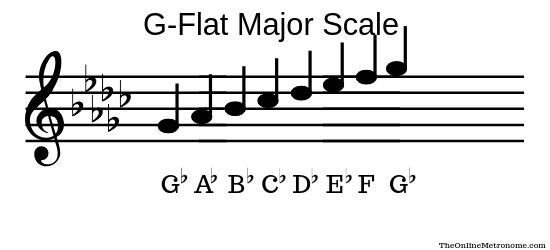
G-Flat major has vi flats, pregnant every note in this scale is flat except for F. (G-flat, A-apartment, B-flat, C-flat, D-flat, Due east-flat).
F-Sharp Major Scale
Now that yous know M-flat, you also know F-sharp. Get through slowly and you'll see that you use the same fingerings and the pitches are the same.
F-Precipitous Major has six sharps: F-sharp, C-sharp, 1000-sharp, D-precipitous, A-sharp, and E-sharp.

The F-sharp major calibration is fabricated upward of the notes: F-abrupt, G-abrupt, A-precipitous, B, C-sharp, D-abrupt, East-sharp, and F-sharp. Its character is described as proclaiming triumph over difficulty (which is certainly true if you try to play through it). This primal tells the story of a difficult struggle and ultimate triumph.
Since this is such an awkward key for many instruments to play, it is rarely used for symphonies. One of the more than famous examples is Mahler'due south Symphony No. 10 in F-sharp. Interestingly, this was Mahler's last symphony and he was unable to complete it before his death. This work picks up right where Symphony No. 9 leaves off (starting with a theme from the previous work) and then works through difficult music filled with mixed meter and dissonance. Finally, it ends in triumph, illustrating the struggle but ultimately a successful end.
A-Flat Major Scale
The key of A-Flat Major has four flats: B-apartment, E-apartment, A-flat, and D-flat.

The A-apartment major scale is fabricated up of the notes: A-flat, B-apartment, C, D-apartment, E-flat, F, G, and A-flat.
This key is a somber 1, often associated with death and judgment. Edward Elgar wrote his commencement symphony in the fundamental of A-flat, though he believed that music shouldn't have to tell a story, rather it can exist but to exist. That said, he described the opening theme (in A-flat Major) as "simple, noble, and elevating." Perhaps it was the somber and elementary nature of A-flat that prompted him to use this key.
B-Apartment Major Calibration
B-flat Major has two flats in the key signature: B-flat and E-flat.
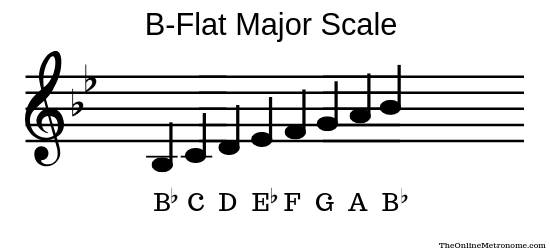
The B-flat Major calibration is made of the notes: B-flat, C, D, Eastward-apartment, F, G, A, and B-apartment. This key is described every bit cheerful and optimistic. A wonderful example of a piece of work in B-flat Major is Prokofiev's Symphony No. v. It was written during Globe War II, which was a very difficult time to exist in Soviet Russia. He described the work as "a hymn to free and happy Man, to his mighty powers, his pure and noble spirit." This beautifully captures the optimism that this piece of work was supposed to convey, making the cardinal of B-flat very appropriate.
How to Practise Scales
Scales are the building blocks of music. Learning scales will allow y'all to more than quickly read notes within a primal signature and to feel more comfortable playing these combinations of fingerings.
Hither is a simple procedure for learning a new scale:
- Print out two copies of the calibration.
- On i copy, write out the fingering for each note underneath the note.
- Going very slowly, and non playing, say the note proper noun and press the fingering for the notation.
- When yous feel comfortable with the fingerings, play through the scale very slowly.
- Repeat this process until you accept done it perfectly ten times.
-
At present that you feel confident with the fingerings, close your eyes and see if you can play the scale perfectly. You've learned the basics of the scale, now it is fourth dimension to get it in rhythm! A technique I recommend is the following:
-
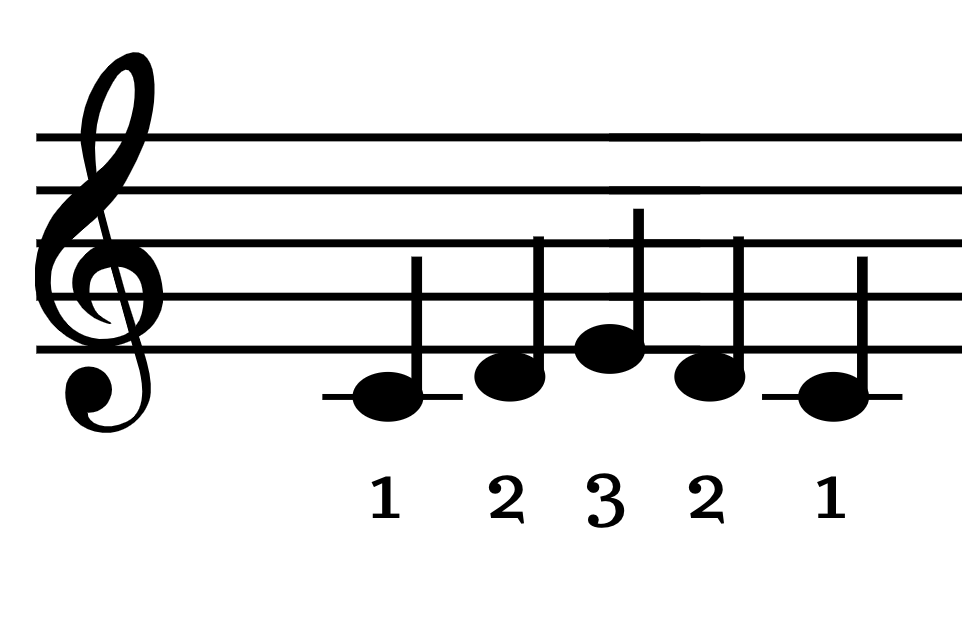
Number the notes of the calibration, 1-eight.
-
Now, you're going to gradually build the scale, flake past flake. Start with but playing 1 - 2 - 1.

-
In one case you tin can play it perfectly 3 times in a row, add another note.
-
Go on building the scale so in this manner. Playing the chunk until you lot have it correct three times in a row, then add together another calibration degree.
-
Repeat until you accept played the entire scale. If you are just starting out, this will be to the eighth scale caste. If y'all are learning multiple octaves, so keep going! Add a 9th, tenth, eleventh scale caste. You know what notes come next as the same eight notes repeat over and over in scales.

Major Scales In Bass Clef,
Source: https://theonlinemetronome.com/blogs/16/major-scales
Posted by: martinhurping.blogspot.com
0 Response to "Major Scales In Bass Clef"
Post a Comment